
You carry a destiny
that can be read.
Enter your date of birth and sex — nothing else. FATE DECODER builds your fate chart automatically from Yin-Yang Five Elements, and the AI reads your destiny back to you, carefully and in plain language.
Chart calculation is free, however many times you run it. Register free and 20 credits come with the account — 5 to 13 AI readings at no cost.
EX. 2018.02.19 → Year 戊戌 35 · Month 甲寅 51 · Day 壬午 19
"Why am I like this?" — the answer is in your fate chart.
Have you carried a difficulty you cannot name, a haze over your life, a question about what any of it is for? FATE DECODER reads your destiny against questions like the ones below, and explains what it finds in plain language.
Why do I keep stumbling in the same place?
It may not be your fault at all — it may come from your destiny. What you have treated as a weakness is often the root of what makes you yourself, or the theme your life is built around. Knowing your own structure gives you a way to live as yourself rather than against yourself.
Why does it never quite work with that person?
It is not that one of you is right and the other wrong. It may simply come from the structure of two destinies. Instead of arguing about feelings, FATE DECODER reads where your structures overlap and where they differ — harmony and friction in phase relationships, ranges of action, producing and restricting cycles — and explains why it goes the way it goes.
Should I move now, or wait?
A life has stretches meant for pushing forward and stretches meant for rest. From ten-year rhythms down to the year, month, and day, FATE DECODER reads your past, your future, and where you are standing now, and gives you a bearing for how to spend this stretch.

The real thing, on screen
A fate chart is a table of stem-branch pairs and star names — technical vocabulary. Without the training of a professional reader, it is genuinely hard to tell what any of it means.
FATE DECODER calculates the chart for you, and then the AI reads what the chart means and explains your destiny carefully, in language you already speak.
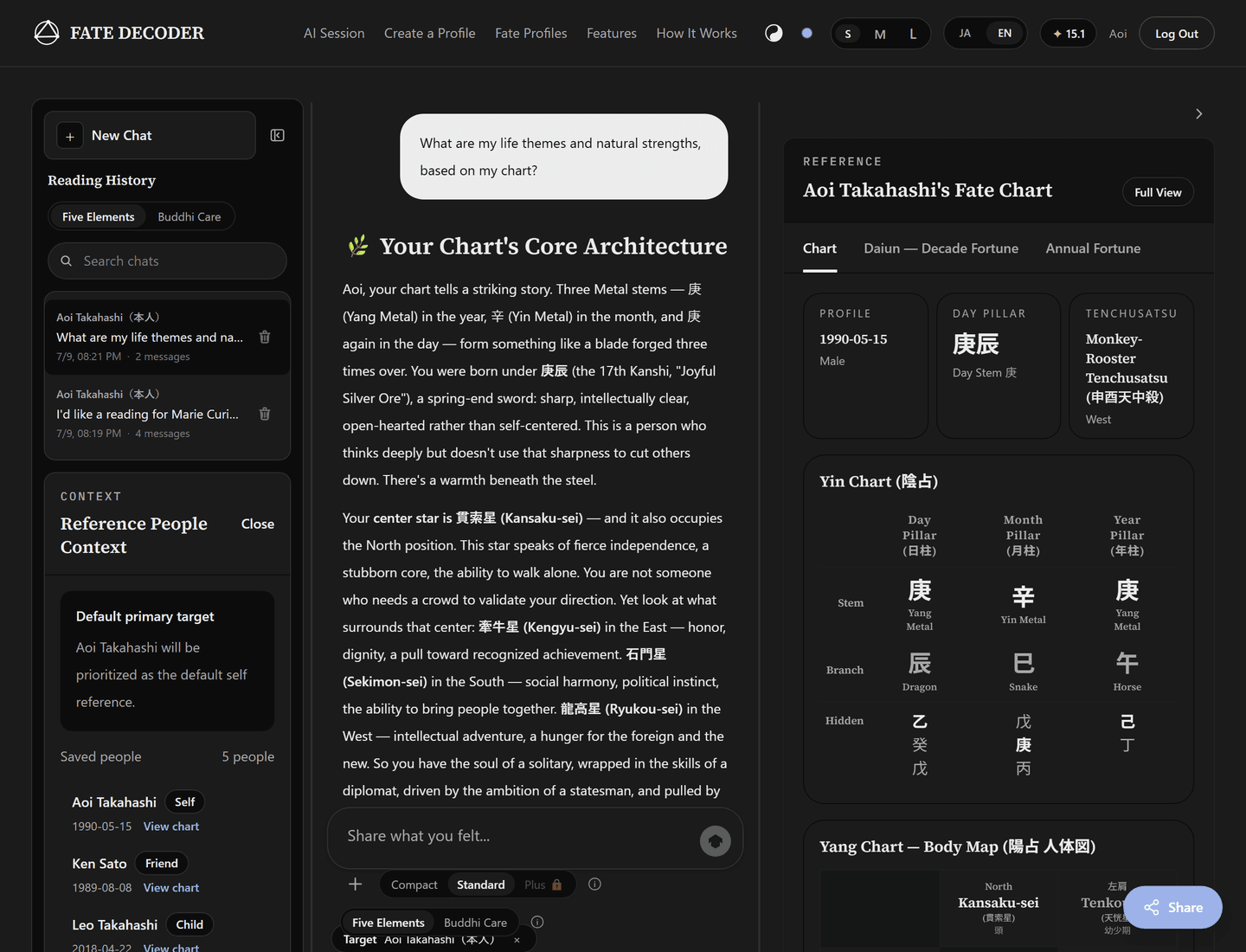
Read the full AI-written reading (about 1,500 words)▾

Anything in the chart or the reading you did not follow, disagreed with, or want to push further on — you can ask, as many times as you like. Each round of questions sharpens the reading and deepens what you understand about yourself.
No account needed. After your chart appears, you get one AI interpretation free. To keep asking, create a free account (20 credits included, no payment info).
Charts are always free. AI readings, 5 to 13 of them free
Creating an account grants you 20 credits at no cost. On Standard that comes to 5-13 readings. What one reading costs depends on what you ask and how long the answer runs, which is why the count is a range.
| Free | Monthly plan | |
|---|---|---|
| Calculating and viewing a chart | Unlimited (no account) | Same |
| Saving charts | Up to 5 people | Unlimited |
| AI reading history | All kept | Same |
| Credits | 20 at sign-up (5-13 readings) | Granted monthly |
Buddhi Care, which draws on Buddhist teaching to offer a bearing on what is troubling you, is also covered by the 20 free credits.
$3 a month — 10 to 26 readings
| Free | Lite | Standard | Plus | |
|---|---|---|---|---|
| Per month | $0 | $3 | $9 | $25 |
| Credits | 20 (one time) | 40/mo | 150/mo | 500/mo |
| AI readings (est.) | 5-13 | 10-26/mo | 37-100/mo | 125-333/mo |
| Saved profiles | 5 | Unlimited | Unlimited | Unlimited |
If you are going to keep using it, a monthly plan is the cheaper way.
The price per credit is lower, and a monthly plan also removes the cap on how many charts you can save.
Credit packs are available too, from $5 for 50 credits (12-33 readings).
There is also 150 credits (37-100 readings) for $10, and 500 credits (125-333 readings) for $30. If you would rather go deep on the occasions you have something to ask, start with a pack.
Cancel at any time. After cancelling, credits granted by a monthly plan stay usable until the end of the contract period; credits bought as a pack are valid for 180 days from purchase.
Every count above is for Standard. What one reading costs depends on what you ask and how long the answer runs, so the figures are given as a low and a high. Long answers push you toward the low end.
No payment information required. You begin with a free account carrying 20 credits — 5 to 13 AI readings.
The study behind your chart
What FATE DECODER reads with rests on Yin-Yang Five Elements theory, which took shape in China roughly 2,500 years ago. That philosophy read the movement of the heavens and the patterns of nature; applying it to a person's date of birth is what produces a fate chart.
FATE DECODER puts that precise calculation logic into software as it stands. Enter a birth date and it derives your elemental balance, the stars that mark your talents, the strength of your energy, and the ten-year turns of your cycles — as data. The AI then reads that data.
Use it as a tool: knowing the initial settings you were given, and opening up a life that is recognisably your own. Readings are written in plain language wherever possible, but showing the grounds inevitably brings in technical terms. When one loses you, ask the AI — or see the "How it works" page, which explains the basic vocabulary.

Try it on someone whose life you already know
Whether your own reading is accurate can be hard to judge from the inside. When that is the case, you can test it on a historical or public figure whose life you know well.
Give the AI a name in a reading and it will look up the published birth date and read it. A figure from history, a founder you admire, a public figure you follow — any of them works.
You can see for yourself whether the arrangement of the stars lines up with how that person actually lived.

Frequently asked questions
How much can I use for free?
Calculating and viewing a fate chart is free, without an account, as many times as you like. Creating an account adds 20 credits, 5 to 13 AI readings. You can save up to 5 people. Your AI reading history is kept in full, on the free plan too.
What do credits get used for, and how fast?
They are used for AI readings: 1.0-4.0 credits per reading on Standard and on Compact, landing nearer the upper end as the answer runs longer. That is why the "AI readings" figure on screen is given as a range. Calculating and viewing a chart uses no credits.
Do credits expire? What happens when I run out?
Credit packs and the sign-up bonus last 180 days from the date they are granted; a subscription's monthly credits last until the end of the following month. Whichever expires soonest is spent first. When you run out, AI readings stop — but calculating and viewing charts stays free at a zero balance.
Can I cancel at any time?
Yes. After cancelling you return to the free plan's limits. Credits granted by a subscription remain usable until the end of the contract period, and credits bought as a pack remain usable for 180 days from purchase.
Should I choose a subscription or a credit pack?
If you use AI readings every month, a monthly plan works out cheaper. A monthly plan is also the only thing that lifts the caps — if you want to save 6 or more people, or keep all of your reading history. If your usage varies a lot from month to month, a pack wastes less.
What happens to the data of the people I save?
The profiles you save and your AI reading history are stored against your account. They are never visible to other users.
How is this different from fortune-telling?
FATE DECODER uses Yin-Yang Five Elements as a framework for self-understanding, not prediction. Yin-Yang Five Elements theory is a 2,500-year-old observational system — closer to a natural philosophy than to fortune-telling.
What can a birth date alone actually tell me?
From the stem-branch combinations of the year, month, and day, a full set of reading data is derived: elemental balance, the Ten Major Stars (nature), the Twelve Supporting Stars (energy), your Tenchusatsu group, phase relationships, and annual timing.
How does this relate to BaZi or Four Pillars?
They share a root, but they are not the same system. Both read the stem-branch calendar, and the ten stem-relationships line up one to one — what BaZi calls the Ten Gods, this method calls the Ten Major Stars. The structural difference is the count: BaZi means "eight characters" because it reads four pillars, including the hour of birth. This Japanese method reads three — year, month, and day — which is why no birth time is asked for here.
Read it, and the meaning changes.
It starts with entering a date of birth. No account, no payment.